VPN Extension Edge: How to Choose and Use One Safely

Find out what an Edge VPN extension can do, how to choose one, and what to check before installing it.
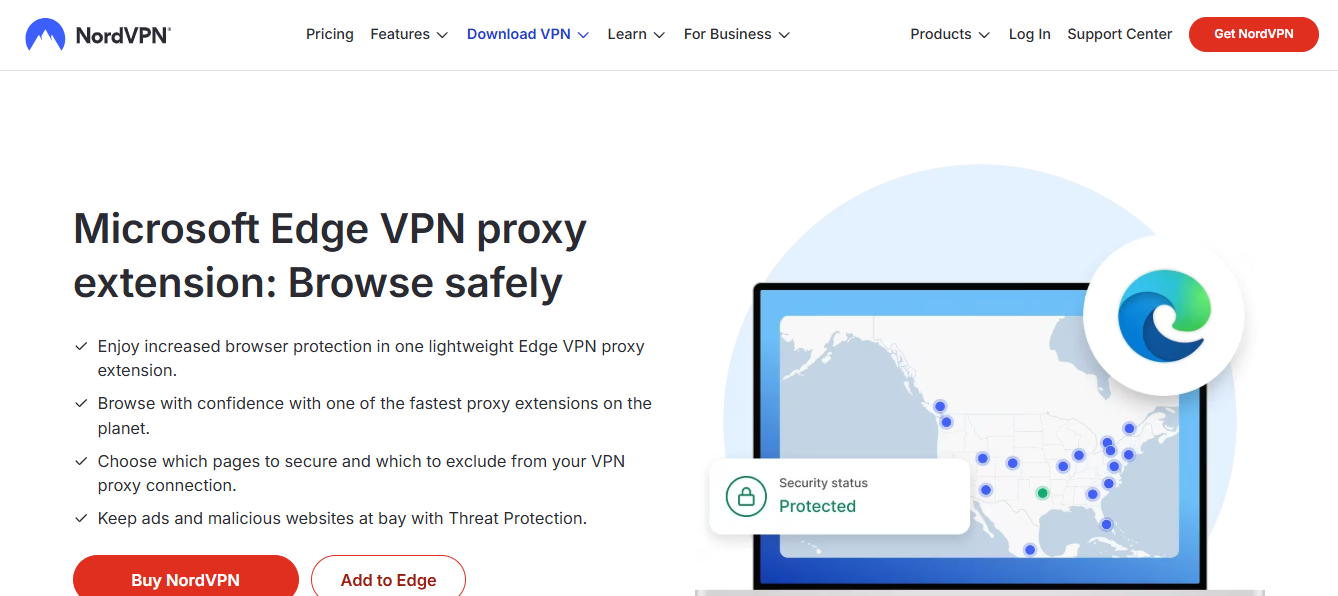
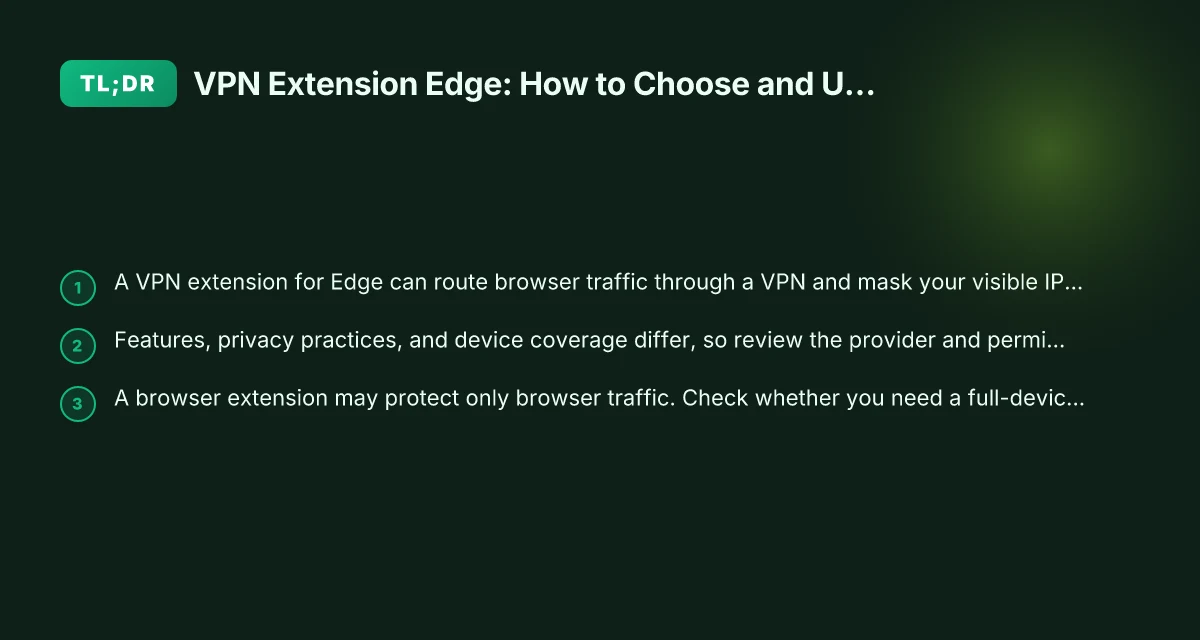
A VPN extension for Edge adds VPN features to your browser, which can help protect browsing traffic and change the IP address websites see. Options in Microsoft Edge Add-ons include VeePN and Browsec VPN. The right choice depends on what you need: simple browser privacy, broader device protection, or a particular provider’s features. Before installing one, check what traffic it covers, how it handles your data, and whether its terms fit your needs.
Editor's pick: NordVPN — fast, secure VPN — Strong encryption, a no-logs policy and apps for every device. 30-day money-back guarantee. Get NordVPN →
Edge VPN, built-in features, and extension types
| Option | Covers browser traffic | Covers other apps | Setup | Main limitation |
|---|---|---|---|---|
| Edge built-in VPN | Not generally available as a standard VPN feature | No | No VPN setup in Edge | Edge does not include a conventional built-in VPN |
| VPN browser extension | Usually browser traffic | Usually no | Install from Edge Add-ons or a compatible store | Protection may not extend beyond the browser |
| VPN desktop app | Usually all device traffic | Yes | Install and connect through the app | Requires a separate app |
| Proxy extension | Browser traffic routed through a proxy | No | Install and choose a location | May not provide VPN-level encryption |
| Private browsing mode | No VPN routing | No | Open an InPrivate window | Does not hide your IP address from websites |
| HTTPS connection | Encrypts the connection to a website | No | Visit an HTTPS site | Does not replace a VPN |
Compiled November 2026; check the provider's site for current details.
| VPN | Obfuscation | From / month | Plan | Free plan | Refund | Alipay | UnionPay | Crypto | Website opens in China | Trustpilot | |
|---|---|---|---|---|---|---|---|---|---|---|---|
 Surfshark | ✓ On by default Camouflage, with OpenVPN | See site | See site | No | 30 days | ✗ | ✗ | ✗ | ✓ | ✗ Blocked | 4.3/5 (31,823 reviews) |
 ZoogVPN | Turn on manually Shadow | $2.49/mo | 27 months: $59.99 | Yes | 7 days | ✓ | ✓ | ✓ | ✓ | Official site blocked; our special link opens (4.4 s) | 4.2/5 (195 reviews) |
 NordVPN | Turn on manually Obfuscated Servers / NordWhisper | $3.49/mo | 27 months: $94.23 | No | 30 days | ? | ✗ | ✓ | ✓ | ✗ Blocked | 4.2/5 (51,628 reviews) |
 ExpressVPN | ✓ On by default all servers | $3.00/mo | 28 months: $84 | No | 30 days | ✗ | ✗ | ✓ | ✗ | ✗ Blocked | 4.4/5 (29,706 reviews) |
 Proton VPN | Turn on manually Stealth, free plan too | $2.99/mo | 12 months: $35.88 | Yes | 30 days | ✗ | ✗ | ✗ | ✓ | ✗ Blocked | 2.1/5 (1,040 reviews) |
 Astrill VPN | Turn on manually StealthVPN / OpenWeb | $12.50/mo | 24 months: $300 | No | See site | ✗ | ✗ | ✗ | ✓ | ✗ Blocked | 1.3/5 (110 reviews) |
 Private Internet Access | Turn on manually Shadowsocks, OpenVPN only | $2.03/mo | 40 months: $81.2 | No | 30 days | ✗ | ✗ | ✗ | ✗ | ✗ Blocked | 4.2/5 (11,033 reviews) |
 CyberGhost | Turn on manually selected servers | $2.19/mo | 28 months: $61.32 | No | 45 days | ✗ | ✗ | ✗ | ✓ | ✗ Blocked | 4.0/5 (24,178 reviews) |
 PureVPN | Turn on manually switch to OpenVPN | $1.69/mo | 60 months: $101.55 | No | 31 days | ? | ? | ✗ | ✓ | ✗ Blocked | 4.4/5 (17,994 reviews) |
 AdGuard VPN | ✓ On by default TrustTunnel | $2.99/mo | 24 months: $71.76 | Yes | 30 days | ✓ | ✗ | ✓ | ✓ | Official site blocked; our special link opens (3.7 s) | 4.3/5 (290 reviews) |
 Mullvad | Turn on manually QUIC / Shadowsocks / LWO | $5.61/mo | €5/mo | No | 14 days | ✗ | ✗ | ✗ | ✓ | ✗ Blocked | 3.2/5 (192 reviews) |
 Windscribe | Turn on manually Stealth / WStunnel | $5.75/mo | 12 months: $69 | Yes | See site | ✗ | ✗ | ✗ | ✓ | ✗ Blocked | 4.7/5 (13,355 reviews) |
 StrongVPN | Turn on manually Scramble, OpenVPN TCP | See site | See site | No | 30 days | ✓ | ✗ | ✗ | ✗ | ✗ Blocked | 4.4/5 (2,695 reviews) |
 LightXtreme 闪连 | Not listed | $7.08/mo | 12 months: $84.99 | Yes | 30 days | ✓ | ✓ | ✓ | ✓ | ✓ Yes (3.5 s) | No page |
Prices checked 2026-11-10 on each vendor's pricing page (cheapest long plan, USD). Check the vendor's checkout for the final price.
Obfuscation checked 2026-11-14 on each vendor's site and help center: "on by default" = nothing to set; "turn on manually" = switch protocol or mode in settings; "not listed" = the vendor describes no obfuscation.
Payment methods checked 2026-11-10 on each vendor's payment pages: all 14 take cards and PayPal; ✗ = not listed, ? = the vendor's own pages disagree.
China access: whether the official website opens from mainland China networks (tests the website only, not the VPN connection). Last checked 2026-11-18 01:02 Beijing time.
Trustpilot score and review count checked 2026-11-10.
What a VPN extension for Edge does
A VPN extension is an add-on you install in Microsoft Edge. Depending on the service, it can connect your browser through a VPN server, helping conceal your regular IP address from websites and protecting browser traffic on the connection.
That does not automatically mean every app on your computer uses the VPN. Some extensions work only with browser traffic, while a provider’s separate VPN app may cover more of the device. Read the product description to understand what is included.
A VPN extension can be useful when you want to:
- Route browser activity through a VPN service.
- Make your regular IP address less visible to websites.
- Use a different virtual location, if the provider offers that feature.
- Manage a VPN connection directly from Edge.
A VPN is not a guarantee of complete anonymity or safety. It does not make suspicious downloads, phishing links, or unsafe account practices harmless. OVPN File: What It Is, How to Open It, and How to Use It
Does Microsoft Edge have a built-in VPN?
Microsoft Edge does not provide a general-purpose VPN service simply by being the browser. To use a VPN with Edge, you can install a browser extension from Microsoft Edge Add-ons or use a VPN app on your device.
A browser extension and a full VPN app are not interchangeable in every case. If you need protection for traffic beyond Edge, check whether the provider offers a separate app and confirm which applications it covers. If you only want VPN routing while browsing in Edge, an extension may be more convenient.
How to assess an Edge VPN extension
| Check | Prefer | Caution sign | Why it matters |
|---|---|---|---|
| Publisher | Identifiable provider | Unknown or hard-to-verify publisher | Helps assess accountability |
| Permissions | Limited and relevant | Broad access without a clear reason | Extensions can access browser data |
| Privacy policy | Clear data practices | Vague collection or sharing terms | Shows how activity data may be handled |
| Encryption | Explicitly explained | No details about protection | A proxy may not encrypt traffic |
| Logging | Clear limits on retained activity | Unclear logging practices | Activity records can affect privacy |
| Independent reviews | Credible, consistent evidence | Few reviews or repeated complaints | Helps spot reliability concerns |
| Business model | Transparent pricing or funding | Free service with unclear funding | Free access may involve trade-offs |
| Updates and support | Recent updates and reachable support | Abandoned listing or no support details | Maintenance can affect security |
Compiled November 2026; check the provider's site for current details. What Is a.ovpn File and How Do You Open One?
How to choose an Edge VPN extension
Start with the provider’s privacy information rather than relying on a “free” or “secure” label. Look for clear explanations of what data is collected, how it is used, and whether connection activity is recorded. Claims such as “no logs” are provider statements, so review the supporting policy and any available independent information.
Also check these practical details:
- Traffic coverage: Does the extension handle only Edge traffic, or does it require a companion app?
- Features: Does it offer the locations, connection controls, or protections you actually want?
- Permissions: Are the requested browser permissions relevant to the service?
- Limits and terms: Confirm whether the free plan has restrictions and what changes on a paid plan.
- Support and updates: Check that the add-on is maintained and that help is available if connection problems arise.
| Option | Where it appears | What to check |
|---|---|---|
| VeePN | Microsoft Edge Add-ons and a VeePN Edge product page | Review its privacy terms, features, and whether the extension or app best matches your needs. |
| Browsec VPN | Microsoft Edge Add-ons | Check its current feature set, privacy policy, and any plan limits. |
| Surfshark | Surfshark’s Edge download page | Confirm which features require a subscription and whether you want the extension or device app. |
The table identifies options shown in the available search results. It is not a ranking or a guarantee that any service is best for every user.
Is a free VPN extension safe to use?
A free extension can be legitimate, but “free” alone does not tell you how well it protects your privacy. Review the provider’s privacy policy, the extension’s permissions, and its listing in the official Edge Add-ons store. Be cautious if the service gives little information about its operator or data practices. Best VPN Extension for Edge: How to Choose the Right One
Before installing, consider:
- Open the listing from Microsoft Edge Add-ons and confirm the publisher.
- Read the description and privacy information, not just the headline claims.
- Check recent reviews for recurring reports of connection or support problems.
- Install only the extension you intend to use, and remove it if you no longer need it.
- Test your connection and confirm the extension shows that it is connected before relying on it.
No extension can prevent every online threat. Keep Edge and your operating system updated, use strong unique passwords, and be alert to suspicious websites.
Choosing between free and paid VPN extensions
| Decision factor | Free extension | Paid extension | Before choosing |
|---|---|---|---|
| Price | No direct subscription fee | Subscription or plan fee | Check renewal terms |
| Data limits | May have limits | Depends on the plan | Confirm usage rules |
| Server choice | May be limited | May offer more locations | Check available locations |
| Privacy terms | Vary by provider | Still require review | Read the privacy policy |
| Performance | May vary | Depends on provider and network | Look for credible testing |
| Support | May be limited | May include more support | Check support channels |
| Coverage | Often browser-only | Browser-only or app-based | Confirm what traffic is covered |
| Best fit | Occasional, low-risk browsing after checks | Regular use when terms and provider are trusted | Avoid either option if its practices are unclear |
Compiled November 2026; check the provider's site for current details. VPN FortiClient: What It Is, How to Connect, and What to Know
How to install and use one
To get started, open Microsoft Edge Add-ons, search for the provider’s name, and open its listing. Review the publisher, permissions, and terms, then choose the option to add the extension. Once installed, use its toolbar icon to sign in or connect, following the provider’s instructions.
If you cannot see the icon, check Edge’s extensions menu and pin it to the toolbar if that option is available. When using the extension, confirm its connection status and check the provider’s guidance for selecting a location or changing settings. Disconnect it when you no longer want browser traffic routed through the service.
Recommendation
For a VPN extension in Edge, begin with a reputable provider’s official listing and compare privacy practices, traffic coverage, and plan terms before installing. VeePN and Browsec VPN appear in the Edge Add-ons results, while Surfshark offers an Edge download page. Choose an extension for browser-focused use. If you want VPN coverage beyond Edge, check whether the provider’s full-device app is the better fit.